Health check-in

Health check-in

Designed a personalised feeding adjustment experience that helps customers manage their dog’s weight goals and stay on track with their subscription.

Outcome:

  • 2% increase in retention among engaged users

  • 4% reduction in customer care tickets related to feeding and weight adjustments

Designed a personalised feeding adjustment experience that helps customers manage their dog’s weight goals and stay on track with their subscription.

Outcome:

  • 2% increase in retention among engaged users

  • 4% reduction in customer care tickets related to feeding and weight adjustments

Role

UX Designer - UI tester

UX Designer - UI tester

Duration

8 weeks

8 weeks

Platform

Mobile, Desktop

Mobile, Desktop

Toolkit

Figma, Figjam, Asana

Figma, Figjam, Asana

The challenge

The challenge

As dogs' weight changed over time, customers often noticed that their current feeding recommendation no longer felt appropriate.

However, there was no simple way to update feeding guidance without contacting customer support or manually changing information elsewhere in the account.

This created several challenges:

  • Feeding plans could become misaligned with a dog's current needs.

  • Customers lacked confidence in making feeding adjustments themselves.

  • Customer support received recurring queries about weight changes and feeding amounts.

  • Some customers questioned the effectiveness of the product when expected results were not achieved

    The challenge was not simply updating a feeding plan. It was helping customers feel confident enough to take action independently.

Project goals

Ensure weight changes are acknowledged and reflected in feeding plans

Support customers who feel unsure about feeding adjustments

Reduce support dependency by giving self-serve control to customers

Understanding the problem

Understanding the problem

To better understand customer behaviour, I reviewed support conversations, existing customer feedback, and internal business insights.

A recurring pattern emerged:

  • Customers recognised when their dog had gained or lost weight, but many were unsure whether they should adjust feeding amounts themselves.

  • Instead of acting, they often contacted customer support for reassurance.

To better understand customer behaviour, I reviewed support conversations, existing customer feedback, and internal business insights.

A recurring pattern emerged:

  • Customers recognised when their dog had gained or lost weight, but many were unsure whether they should adjust feeding amounts themselves.

  • Instead of acting, they often contacted customer support for reassurance.

Key insights

Key insights

  • Customers were not looking for complex nutritional advice.

  • They simply wanted confidence that they were making the right decision.

  • This insight shifted the focus from creating a recommendation engine to designing a guided self-serve experience that balanced clarity, control, and reassurance.

Primary user persona - The health-proactive dog parent

Primary user persona - The health-proactive dog parent

Age:

35y/o

Occupation:

Branch manager

Location:

Glasgow, UK

Dog:

Rozy the Poodle: 8 months

Rozy & Angela

I know when something feels off, I just need a safe way to change it myself.

About

Angela wants to ensure her dog stays at an ideal healthy weight and appreciates tools that allow them to track progress and adjust feeding confidently.

Motivation

Keep dog healthy, avoid over/under feeding.

Behaviour

Noticed unexpected change in her dog’s weight after starting to feed Pure.

Pain points

Unsure how to adjust scoops, doesn’t want to wait for support.

Project goals

Ensure weight changes are acknowledged and reflected in feeding plans

Reduce support dependency by giving self-serve control to customers

Support customers who feel unsure about feeding adjustments

Phase 1 - Problem validation

Phase 1 - Problem validation

Validating the opportunity

Validating the opportunity

  • Before investing in a complete solution, we tested whether customers would engage with a lightweight intervention.

  • The initial experiment focused on encouraging customers to acknowledge weight changes and confirm whether adjustments were needed.

  • The results validated the opportunity and demonstrated that customers were willing to engage when the process felt simple and low effort.

  • This gave confidence to move forward with a more comprehensive self-serve experience.

Experiment results

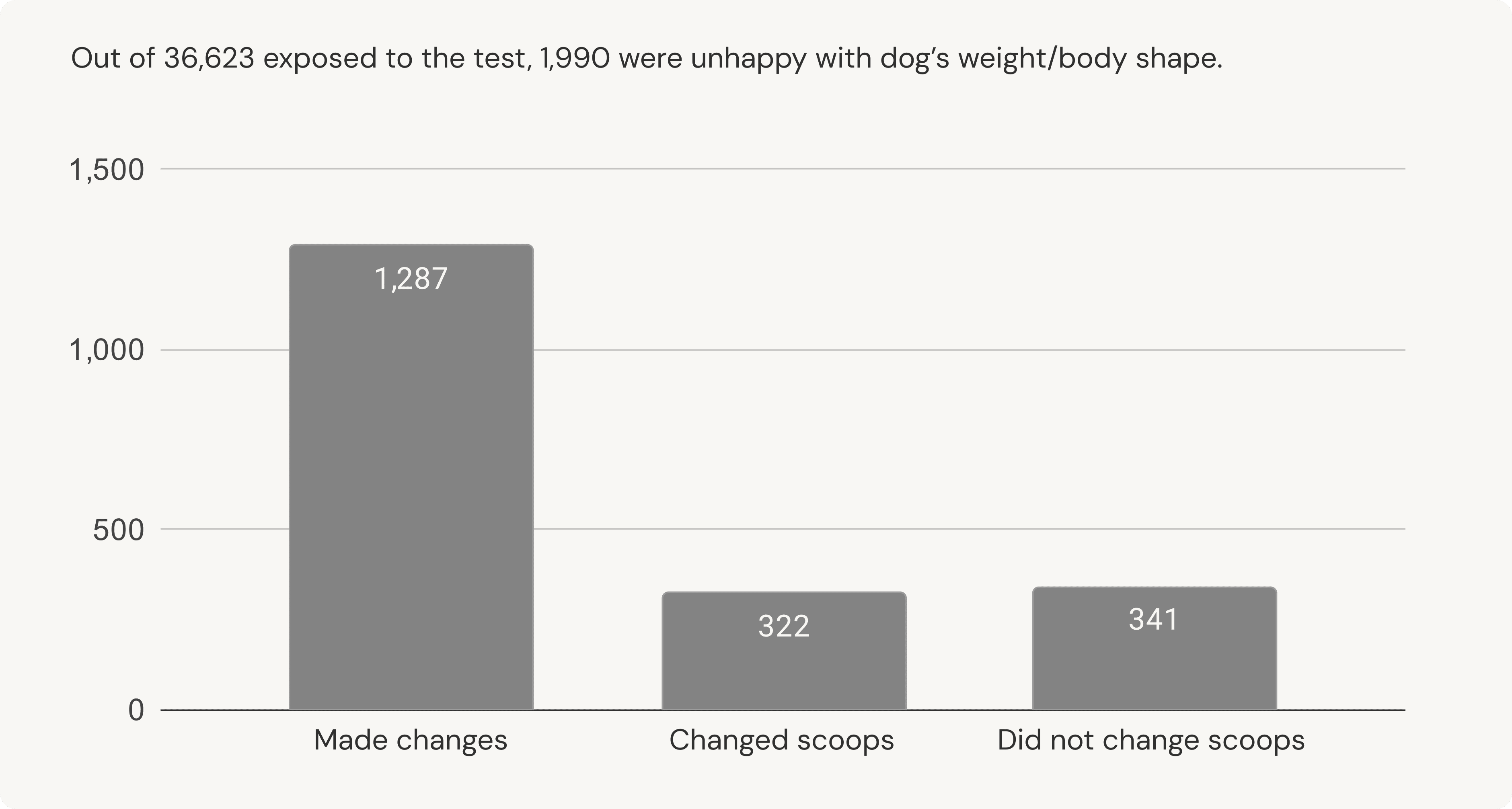
50,000 +

users interacted with the weight check-in prompt within 6 weeks

users interacted with the weight check-in prompt within 6 weeks

15%

user said they were unhappy with their dog’s weight

user said they were unhappy with their dog’s weight

65%

of those 15% said the dog was underweight, not overweight

of those 15% said the dog was underweight, not overweight

Phase 2 - Offering solution and A/B test

Phase 2 - Offering solution and A/B test

Design principles

Design principles

  • Keep it lightweight - Customers needed a quick answer, not a lengthy assessment.

  • Give users control - Customers wanted the ability to adjust feeding plans themselves rather than being forced through expert recommendations.

  • Provide reassurance - Support should remain available for customers who needed additional confidence or guidance.

  • Keep the experience contextual - The solution should live within the existing account experience rather than introducing new navigation paths or disconnected journeys.

Key UX decisions

Key UX decisions

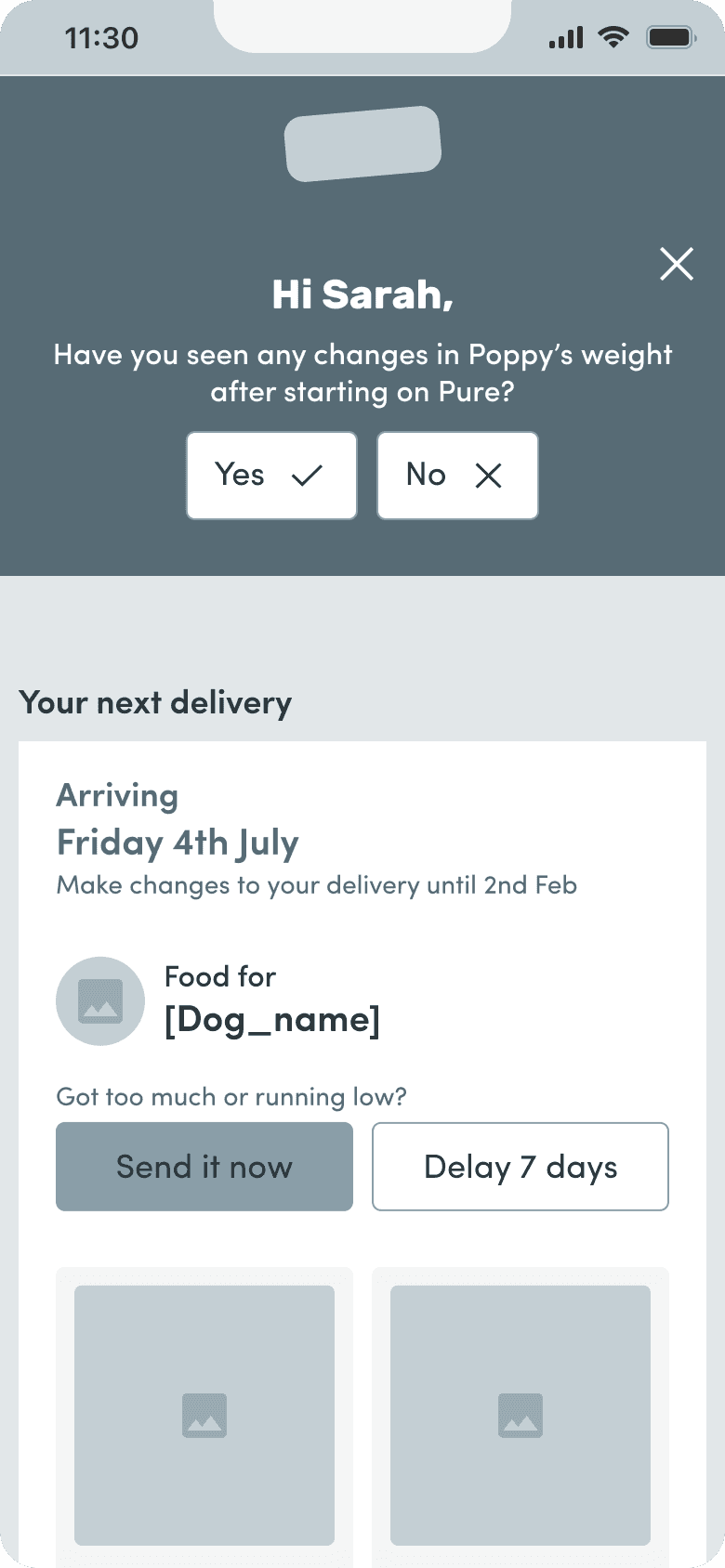
  • Simple entry point - A binary question reduced cognitive load and encouraged participation.

  • Immediate feedback - Changes were reflected instantly within the feeding plan, reinforcing trust and confidence.

  • Control-first approach - Customers could make adjustments themselves without unnecessary barriers.

  • Optional support - Additional help remained available for customers requiring further guidance, while keeping self-service as the primary path.

What's in scope?

Ability to update feeding plans which reflect up-to-date weight information through the account

Ability to update feeding plans which reflect up-to-date weight information through the account

Define and apply consistent rules for when subscription adjustments are required

Define and apply consistent rules for when subscription adjustments are required

Adding to sub-app for CS to see weight check-ins inc. any adjustments

Adding to sub-app for CS to see weight check-ins inc. any adjustments

Exploration & design development

Exploration & design development

Competitor analysis

Competitor analysis

Conducted competitor analysis to understand how pet care and subscription products handle plan adjustments.

Conducted competitor analysis to understand how pet care and subscription products handle plan adjustments.

User flow

User flow

User flow was created to understand all affected areas in the account and identify any loopholes.

User flow was created to understand all affected areas in the account and identify any loopholes.

Scenarios

Scenarios

Created all possible scenarios where the dog’s feeding guide was affected/changed for any reasons.

Created all possible scenarios where the dog’s feeding guide was affected/changed for any reasons.

Base feeding size is 6 scoops for 22kg dog on a regular plan

Base feeding size is 6 scoops for 22kg dog on a regular plan

If:

dog’s feeding scoops are changed from 6 to 6 + 2 for weight management

and:

if CS person change their base scoops from 6 to 9

then:

the base size changes but we should also give CS team an option to remove extra scoops
Base feeding size is 6 scoops for 22kg dog on a regular plan

If:

dog’s feeding scoops are changed from 6 to 6 + 2 for weight management

and:

if the customer wants to remove the extra +2 scoops

then:

offer them an option to remove the scoops in their account

Wireframes

Wireframes

After successfully completing each flow with and assuring that we have covered all the required information, the next step was designing wireframes and exploring multiple solutions before committing to high-fidelity designs. Below are few key screens showcased.

After successfully completing each flow with and assuring that we have covered all the required information, the next step was designing wireframes and exploring multiple solutions before committing to high-fidelity designs. Below are few key screens showcased.

Feedback session with project stakeholders

Feedback session with project stakeholders

Overall impression

Overall impression

The designs present a clear and intuitive flow that aligns well with our project goals

The designs present a clear and intuitive flow that aligns well with our project goals

Layout feedback

Layout feedback

The featured prompt is well-placed and very clear for the users to see

The featured prompt is well-placed and very clear for the users to see

Suggestions

Suggestions

Not to offer direct option to contact the CS team to avoid people calling unncessarily

Not to offer direct option to contact the CS team to avoid people calling unncessarily

The wireframes and prototype helped to showcase to the stakeholders how it’ll work and look once built.

The wireframes and prototype helped to showcase to the stakeholders how it’ll work and look once built.

UI design

UI design

Brand identity

Brand identity

I’ve followed the brand identity throughout the UI process. I used existing brand components in the designs.

I’ve followed the brand identity throughout the UI process. I used existing brand components in the designs.

Component library examples

Colour pallet

Design components

Header

Title

Footer

Dashboard

Pets

Deliveries

Shop

Get £20

1

See buying options

Product cards

Product name

Subtitle

Caption

from

£3.99

Product name

Caption

£3.99

Add to plan

Buttons

Button

Button

Button

Button

Button

Button

Button

Button

Button

Button

Button

Button

Button

Button

Button

Button

High - Fidelity designs

High - Fidelity designs

The final experience allowed customers to:

  • Confirm weight changes.

  • Adjust feeding amounts independently.

  • Understand the impact of changes immediately.

  • View updates directly within their existing feeding plan.

The experience was designed to support multiple household scenarios while keeping decision-making simple and transparent.

Collaboration and delivery

Collaboration and delivery

The project involved close collaboration across Product, Engineering, Customer Support, and stakeholders throughout the design process.

Following design sign-off, I prepared annotated handover documentation and worked closely with engineering during implementation and QA testing.

The project involved close collaboration across Product, Engineering, Customer Support, and stakeholders throughout the design process.

Following design sign-off, I prepared annotated handover documentation and worked closely with engineering during implementation and QA testing.

Outcome and impact

Outcome and impact

Within 8 weeks of rollout, around 20% of customers have confirmed a variance of 3+ scoops

Within 8 weeks of rollout, around 20% of customers have confirmed a variance of 3+ scoops

Results

Results

Following rollout, the Health Check-in experience demonstrated positive outcomes for both customers and the business.


Key takeaways

Key takeaways

What needs to be improved

What needs to be improved

Reflection

Reflection

This project reinforced the importance of balancing guidance with user autonomy.

  • Initially, it was tempting to create a more prescriptive experience. However, research showed that customers primarily wanted reassurance and control rather than expert intervention.

  • By focusing on a simple, self-serve solution, we were able to improve customer confidence, reduce operational burden, and support better long-term subscription outcomes.


The project also highlighted the value of validating assumptions early, using lightweight experiments to reduce risk before investing in a larger solution.

Want to see ideas come alive?

Get in touch to find out more about digital experiences to effectively reach and engage customers and target audiences.

© Rutuja Baviskar UX Portfolio 2026

© Rutuja Baviskar UX Portfolio 2026

Want to see ideas come alive?

Get in touch to find out more about digital experiences to effectively reach and engage customers and target audiences.

© Rutuja Baviskar UX Portfolio 2026

Want to see ideas come alive?

Get in touch to find out more about digital experiences to effectively reach and engage customers and target audiences.