Stock locations
Stock locations
Digitising the process of arranging the received goods from the the suppliers in the warehouse as well as keeping track of their movement within the factory.
Digitising the process of arranging the received goods from the the suppliers in the warehouse as well as keeping track of their movement within the factory.
Role
UX Designer - QA tester
UX Designer - QA tester
Duration
24 weeks
24 weeks
Platform
Desktop
Desktop
Toolkit
Figma, Figjam, Asana
Figma, Figjam, Asana

Understanding the problem
Understanding the problem
Warehouse stock was managed through batch-based tracking with no reliable system for identifying where items physically existed in the warehouse. This created inefficiencies in locating stock, tracking movement, and understanding availability.
Key challenges included:
Key challenges included:
No structured concept of storage locations or bays
Stock tracked only at batch level, not physical position
Limited visibility of pallet distribution across the warehouse
Manual processes increasing risk of misplaced or untracked goods
The goal was to digitise stock locations to improve traceability, operational efficiency, and stock visibility across teams.
No structured concept of storage locations or bays
Stock tracked only at batch level, not physical position
Limited visibility of pallet distribution across the warehouse
Manual processes increasing risk of misplaced or untracked goods
The goal was to digitise stock locations to improve traceability, operational efficiency, and stock visibility across teams.
Hypothesis
Hypothesis
Hypothesis was created as it was crucial to guide the whole process from UX research and design perspective
Hypothesis was created as it was crucial to guide the whole process from UX research and design perspective
By: Digitising stock locations
We will: make it clear what we have in the warehouse
So that: finance can see stock levels
By: Digitising stock locations
We will: make it clear what we have in the warehouse
So that: finance can see stock levels
By: Digitising stock locations
We will: make it easier to locate items
So that: Matty (warehouse operative) can pick the best items to use in mixing
By: Digitising stock locations
We will: make it easier to locate items
So that: Matty (warehouse operative) can pick the best items to use in mixing
By: Digitising stock locations
We will: help to make it clear what shelf space is available
So that: procurement team can by the correct quantities
By: Digitising stock locations
We will: help to make it clear what shelf space is available
So that: procurement team can by the correct quantities
By: Digitising stock locations
We will: help to make it clear what shelf space is available
So that: procurement team can by the correct quantities
Research phase
Research phase
Market research
Market research
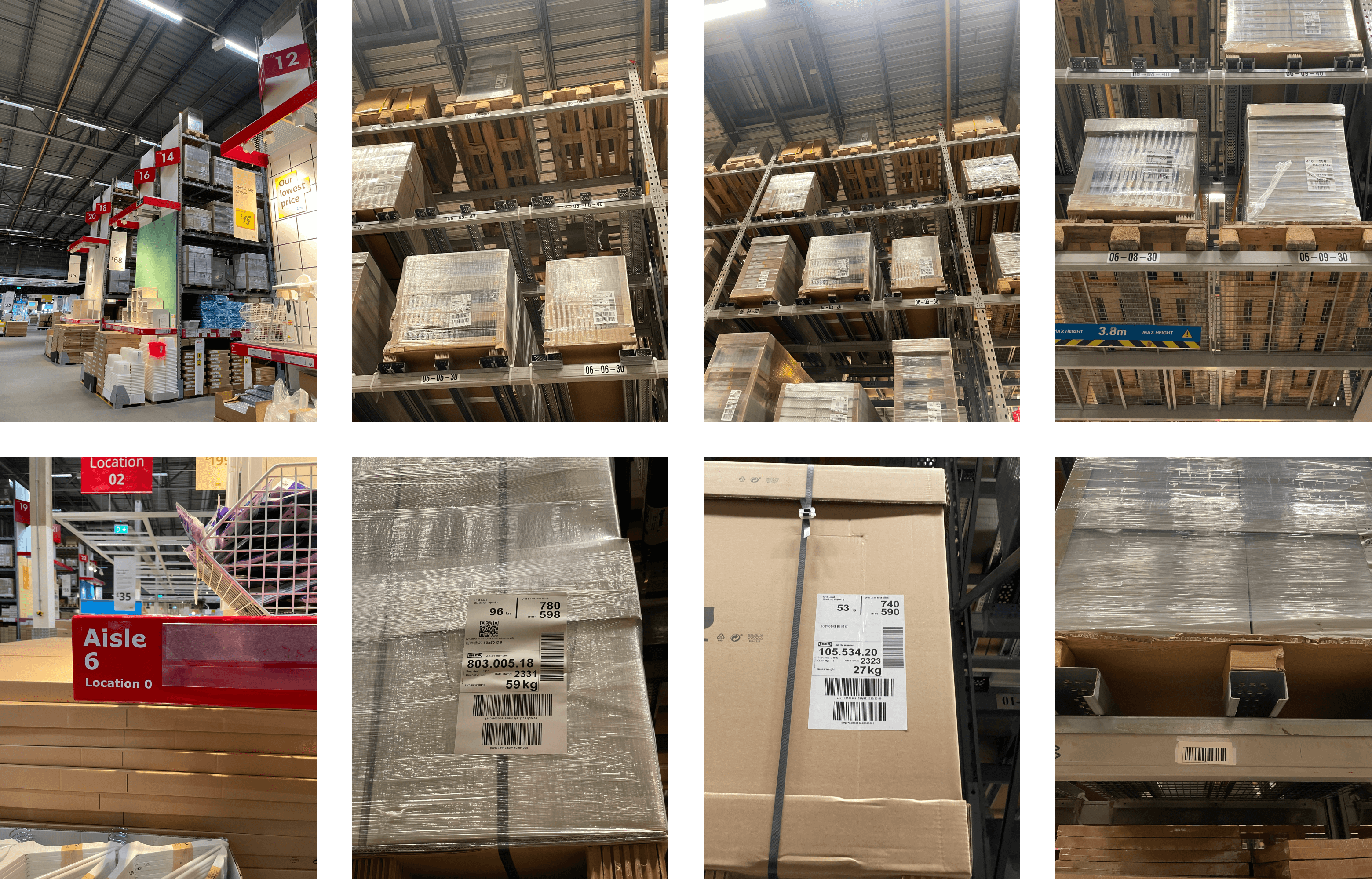
I conducted internal research with warehouse stakeholders and visited external environments (e.g. IKEA warehouse systems) to understand real-world storage logic and scalable structuring.
Key insights:
Structured bay systems (A–Z grids) improve retrieval efficiency
Barcode-level identification is critical for traceability
Storage logic must support stacking, movement, and scanning constraints
I conducted internal research with warehouse stakeholders and visited external environments (e.g. IKEA warehouse systems) to understand real-world storage logic and scalable structuring.
Key insights:
Structured bay systems (A–Z grids) improve retrieval efficiency
Barcode-level identification is critical for traceability
Storage logic must support stacking, movement, and scanning constraints
Mapped all unknowns with warehouse management, including
How multi-item pallets are handeled
Scanning accessibility for higher shelves
2
1
4
Overflow handling when bays are full
Storage capacity limitations
3
System impact
System impact
Introducing stock locations affected multiple areas across the production system. I mapped and aligned updates across key workflows. This ensured the system worked as a connected ecosystem rather than a standalone feature.
Introducing stock locations affected multiple areas across the production system. I mapped and aligned updates across key workflows. This ensured the system worked as a connected ecosystem rather than a standalone feature.

Content sorting
To support a complex warehouse environment, I structured the system into clear functional areas covering stock visibility, movement, and management.
This helped ensure users could quickly locate information, manage stock at different stages (goods in, storage, mixing, and pallet movement), and maintain accurate tracking across the warehouse.
The structure was designed to:
Improve ability to find stock across different warehouse states
Support both search-based and physical location-based workflows
Enable scalable management of bays, pallets, and aisles
Ensure consistency across inventory, goods in, and production flows

Success criteria
To see all the relevant information about stock
Find an exact location of an item using a digital device
Ability to understand the stock levels for re order
User stories
Stock counts on month end - Finance (Jill)
As a finance manager, Jill wants to view stock levels in the warehouse so that she knows the value of stock in the warehouse.

New stock arrives in warehouse - Warehouse manager (Matty)
Matty wants to arrange received stock so that operations and procurement team can see where the stock is located.

Project scope
What’s in scope
Creation of a new stock location area
Locating the internal storage system of the warehouse
Using the FIFO (First in first out) method
A separate shelving unit for misc goods
What’s not in scope
Arranging the goods by type, weight, material or size or having a dedicated bay for any specific goods
Bay suggestions for goods-in
Overly-complex layouts and visuals
Risks
Reliability of stock count and location of the goods if the goods are moved without scanning.
Items not put in formal bay and just left somewhere
Might have to rearrange the goods stored in the warehouse
Dependancies
Ops managing the goods by scanning the codes and arranging the pallets
Ops moving the items from pallets to mixing warehouse
Phil’s internal batch codes working correctly
Process change and training for Ops to use the system
Design approach
Design approach
User flows
User flows
I defined end-to-end user flows covering:
Searching for materials and pallets
Moving stock between locations
Adding and assigning new stock
Viewing and managing warehouse layout
This was followed by:
Information architecture for scalable navigation
Wireframes validated with stakeholders
Iterative refinement based on feedback from the product manager
I defined end-to-end user flows covering:
Searching for materials and pallets
Moving stock between locations
Adding and assigning new stock
Viewing and managing warehouse layout
This was followed by:
Information architecture for scalable navigation
Wireframes validated with stakeholders
Iterative refinement based on feedback from the product manager

Information architecture
Information architecture
Created an information architecture for better understanding of the system’s interface.
Created an information architecture for better understanding of the system’s interface.

Wireframes
Wireframes
Based on the user flows, i’ve started creating wireframes for each reason mentioned in the flow along with the initial product navigation and checkout
Based on the user flows, i’ve started creating wireframes for each reason mentioned in the flow along with the initial product navigation and checkout


Feedback session with project manager
Feedback session with project manager
Overall impression
Overall impression
The flow looks great for navigating and covers all the potential solutions for any possible journey.
The flow looks great for navigating and covers all the potential solutions for any possible journey.
Layout feedback
Layout feedback
The layout of the homepage looks like an exact replica of the warehouse storage.
The layout of the homepage looks like an exact replica of the warehouse storage.
Suggestions
Suggestions
Would be interesting the how the other affected areas would look like after changes.
Would be interesting the how the other affected areas would look like after changes.
The wireframes helped to clearly understand all the possible journeys that were missed in the user flow and the user stories.
The wireframes helped to clearly understand all the possible journeys that were missed in the user flow and the user stories.
UI Design
UI Design
Component library
Component library
We used the colour pallet, typography and other components from our existing component library created for our production app. Also created some new local components needed for the stock locations.
We used the colour pallet, typography and other components from our existing component library created for our production app. Also created some new local components needed for the stock locations.
Buttons

Alert labels

High-fidelity designs
High-fidelity designs
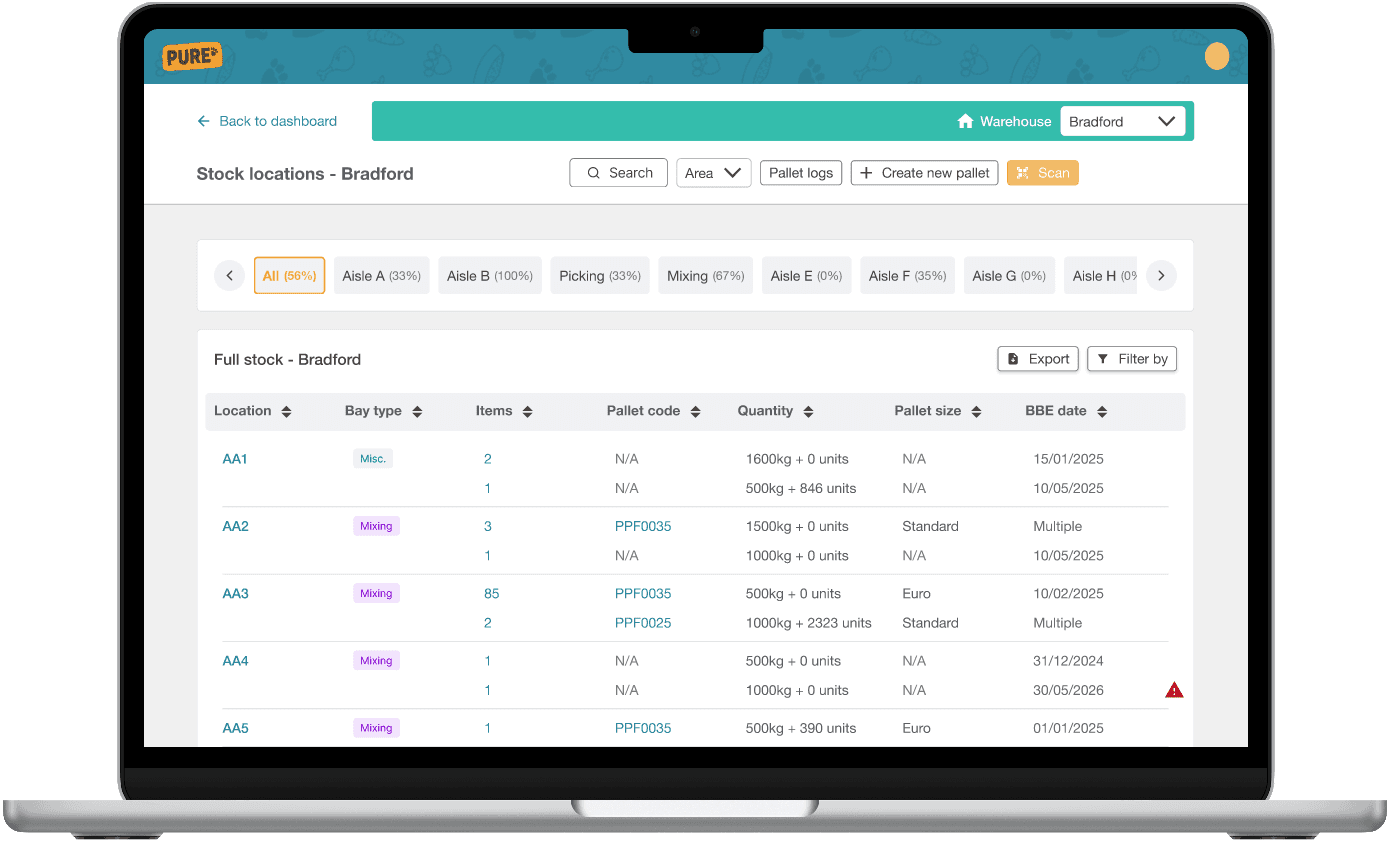
Detailed UI designs were created for all the wireframes and we discovered that a few more areas are needed to be looked at after some user testing.
Detailed UI designs were created for all the wireframes and we discovered that a few more areas are needed to be looked at after some user testing.


QA testing
QA testing
Design handover
Design handover
An interactive prototype was created to clearly communicate user flows and validate the end-to-end experience. This played a key role in the handover session, helping the development team quickly understand interactions, edge cases, and implementation requirements.
An interactive prototype was created to clearly communicate user flows and validate the end-to-end experience. This played a key role in the handover session, helping the development team quickly understand interactions, edge cases, and implementation requirements.

Pre-deploy testing
Pre-deploy testing
Conducted thorough QA due to complex workflows. Bugs were tracked in Asana, resolved iteratively, and the system was successfully deployed after validation.
Conducted thorough QA due to complex workflows. Bugs were tracked in Asana, resolved iteratively, and the system was successfully deployed after validation.

Key learnings
Key learnings
This project reinforced the importance of:
This project reinforced the importance of:
Involving users early to uncover edge cases in complex systems
Designing detailed user flows before moving into UI
Ensuring clear handover documentation to avoid implementation gaps
Considering operational training when introducing system-wide change
Future improvements would focus on:
Future improvements would focus on:
Expanding coverage across all affected production areas
Improving onboarding and training for warehouse teams
Strengthening system resilience for edge-case handling